



2025 Summer Day4
Content:Math
Date:2025.7.20
内容
- 矩阵
- 线性方程组
- 行列式
- 矩阵树定理
- 线性基
具体内容
矩阵
矩阵定义
定义
将一些元素排列成若干行,每行放上相同数量的元素,就是一个矩阵 (Matrix)。
对于矩阵 A 的第 i 行,第 j 列,我们记作 a_{i,j} 或 a_{ij}。
对于举证 A_{m \times n},如果 m = n,则我们称矩阵 A 为方阵。
矩阵基本操作
- 矩阵加法:对于矩阵 A_{m \times n}, B_{m \times n}, 我们定义矩阵加法为 C_{i,j} = A_{i, j} + B_{i, j}
即矩阵对应位置上的元素之和。 - 标量乘法:对于矩阵 A_{m \times n} 和标量 x, 我们定义矩阵的标量乘法为:
- 转置:对于矩阵 A_{m \times n},其转置为:
- 矩阵的拼接:对于矩阵 A_{m \times n_1},B_{m \times n_2},其拼接为记为 (A \ | \ B),其大小为 m \times (n_1 + n_2)。
- 矩阵的乘法:对于矩阵 A_{m \times n} 和矩阵 B_{n \times k},其矩阵乘法定义为:
	其中 $i \in [1,n]$,$j \in [1,k]$。
	对于矩阵乘法,有如下性质:

	+ 矩阵乘法具备分配律:$(A + B)C = AC + BC$;
	+ 矩阵乘法具有结合律:$(AB)C = A(BC)$;
7. 矩阵乘法单位元:
矩阵的乘法单位元 I 为矩阵主对角线上全部为 1,其余均为 0 的 0/1 矩阵。
8. 矩阵的逆:如果对于矩阵 A 存在矩阵 B,使得 AB = I,则 B 称作矩阵 A 的逆元,记作 A^{-1}。
对于逆元我们可以使用高斯消元求解。我们对矩阵 (A \ | \ I) 进行高斯消元,最后会得到 (I \ | \ B) (若无法把左边化为乘法单位元,则矩阵 A 不存在逆元),则 B 就为 A 的逆元。
矩阵与线性方程组
对于线性方程组
将未知数的系数写成矩阵的形式,用系数所在的矩阵的行表示未知数,我们就得到了线性方程组的矩阵 (增广矩阵) 表达形式:
对于线性方程组,我们通常会使用消元来求解。在矩阵表示下的线性方程组可以用高斯消元来求解。
高斯消元是通过对矩阵进行初等变换,以保证在方程的解不变的情况下求出方程的解。一般来说步骤如下 (记增广矩阵为 M):
- 枚举变量 i (i \in [1,m]) 表示当前要对未知元 x_i 进行消元操作。
- 寻找最大的 j \in [i,m],使得 a_{j, i} \ne 0,交换 M_i \longleftrightarrow M_j。
- 将交换后的矩阵的第 i 行的未知元 x_i 的系数化为 1,即: a_{i,j} \leftarrow \frac{a_{i,j}}{a_{i,i}} (j \in [1,m])。
- 用矩阵的第 i 行对矩阵的第 j (j \in [i + 1,m]) 行进行消元操作,即:a_{j,k} \leftarrow a_{j,k} - a_{j,k} \times a_{j,i}。
- 重复上述操作直到 i > n 或者找不到满足条件 2 中的 j。
最后的结果可能会有以下三种
- 如果 i < n,且存在 j 使得 a_{j,n} > 0,则原线性方程组无解。
- 如果 i < n,且对于 \forall j 满足 a_{j,n} = 0,则原线性方程组有无数解。
- 否则原线性方程组有唯一解。
洛谷 P3389 Code
#include <bits/stdc++.h>

using namespace std;

constexpr int N = 105;
constexpr double eps = 1e-8;

class Matrix {
	double mat[N][N] = {{0}};
	int size = 0;

	public:
	Matrix() = default;

	void input_matrix() {
		cin >> size;

		for (int i = 0; i < size; i++)
			for (int j = 0; j <= size; j++)
				cin >> mat[i][j];
	}

	int guess() {
		int i, j, r = 0;
		for (int c = 0; c < size; c++) {
			int t = r;
			for (i = t + 1; i < size; i++) {
				if (abs(mat[i][c]) > abs(mat[t][c])) {
					t = i;
				}
			}

			if (abs(mat[t][c]) < eps) continue;

			for (i = c; i <= size; i++) {
				swap(mat[t][i], mat[r][i]);
			}

			for (i = size; i >= c; i--) {
				mat[r][i] /= mat[r][c];
			}

			for (i = r + 1; i < size; i++) {
				if (abs(mat[i][c]) > eps) {
					for (j = size; j >= c; j--) {
						mat[i][j] -= mat[r][j] * mat[i][c];
					}
				}
			}

			r++;
		}

		if (r < size) {
			return -1;
		}

		for (i = size - 1; i >= 0; i--) {
			for (j = i + 1; j < size; j++) {
				mat[i][size] -= mat[i][j] * mat[j][size];
			}
		}

		return 1;
	}

	int get_size() const { return size; }

	double get_solution(int i) const { return mat[i][size]; }
};

int main() {
	ios::sync_with_stdio(false);
	cin.tie(nullptr);
	cout.tie(nullptr);

	Matrix matrix;

	matrix.input_matrix();

	if (matrix.guess() == -1) {
		cout << "No Solution\n";
	} else {
		for (int i = 0; i < matrix.get_size(); i++) {
			double answer = matrix.get_solution(i);
			if (abs(answer) < eps) {
				answer = 0;
			} else {
				answer = round(answer * 100.00) / 100.00;
			}

			cout << setiosflags(ios::fixed) << setprecision(2) << answer << "\n";
		}
	}

	return 0;
}
洛谷 P2455 Code
#include <bits/stdc++.h>

using namespace std;

const int N = 110;
const double eps = 1e-8;
int n;
double a[N][N];

int gauss() {
	int i, j, c, r = 0;

	for (c = 0; c < n; c ++) {
		int t = r;
		for (i = t + 1; i < n; i ++)
			if (abs(a[i][c]) > abs(a[t][c])) t = i;

		if (abs(a[t][c]) < eps) continue;

		for (i = c; i <= n; i ++) swap(a[t][i], a[r][i]);

		for (i = n; i >= c; i --) a[r][i] /= a[r][c];

		for (i = r + 1; i < n; i ++)
			if (abs(a[i][c]) > eps)
				for (j = n; j >= c; j --)
					a[i][j] -= a[r][j] * a[i][c];

		r ++;
	}

	if (r < n) {
		for (i = r; i < n; i ++)
			if (abs(a[i][n]) > eps) return 2;
		return 1;
	}

	for (i = n - 1; i >= 0; i --)
		for (j = i + 1; j < n; j ++)
			a[i][n] -= a[i][j] * a[j][n];

	return 0;
}

int main() {
	scanf("%d", &n);

	for (int i = 0; i < n; i ++) {
		for (int j = 0; j <= n; j ++) {
			scanf("%lf", &a[i][j]);
		}
	}

	int t = gauss();
	if (t == 2) puts("-1");
	else if (t == 1) puts("0");
	else {
		for (int i = 0; i < n; i ++) {
			printf("x%d=", i + 1);
			if (abs(a[i][n]) < eps) a[i][n] = 0;
			printf("%.2lf\n", a[i][n]);
		}
	}

	return 0;
}
除了高斯消元外,我们还有另外一种消元的方式——高斯-约旦消元,下面给出代码。
洛谷 P3389 Code
#include <bits/stdc++.h>

using namespace std;

constexpr int N = 105;
constexpr double eps = 1e-8;

class Matrix {
	double mat[N][N] = {{0}};
	int size = 0;

	public:
	Matrix() = default;

	void input_matrix() {
		cin >size;

		for (int i = 0; i < size; i++)
			for (int j = 0; j <= size; j++)
				cin >mat[i][j];
	}

	int guess() {
		int i, j, r = 0;
		for (int c = 0; c < size; c++) {
			int t = r;
			for (i = t + 1; i < size; i++) {
				if (abs(mat[i][c]) abs(mat[t][c])) {
					t = i;
				}
			}

			if (abs(mat[t][c]) < eps) continue;

			for (i = c; i <= size; i++) {
				swap(mat[t][i], mat[r][i]);
			}

			for (i = size; i >= c; i--) {
				mat[r][i] /= mat[r][c];
			}

			for (i = r + 1; i < size; i++) {
				if (abs(mat[i][c]) eps) {
					for (j = size; j >= c; j--) {
						mat[i][j] -= mat[r][j] * mat[i][c];
					}
				}
			}

			r++;
		}

		if (r < size) {
			return -1;
		}

		for (i = size - 1; i >= 0; i--) {
			for (j = i + 1; j < size; j++) {
				mat[i][size] -= mat[i][j] * mat[j][size];
			}
		}

		return 1;
	}

	int get_size() const { return size; }

	double get_solution(int i) const { return mat[i][size]; }
};

int main() {
	ios::sync_with_stdio(false);
	cin.tie(nullptr);
	cout.tie(nullptr);

	Matrix matrix;

	matrix.input_matrix();

	if (matrix.guess() == -1) {
		cout << "No Solution\n";
	} else {
		for (int i = 0; i < matrix.get_size(); i++) {
			double answer = matrix.get_solution(i);
			if (abs(answer) < eps) {
				answer = 0;
			} else {
				answer = round(answer * 100.00) / 100.00;
			}

			cout << setiosflags(ios::fixed) << setprecision(2) << answer << "\n";
		}
	}

	return 0;
}
行列式
定义
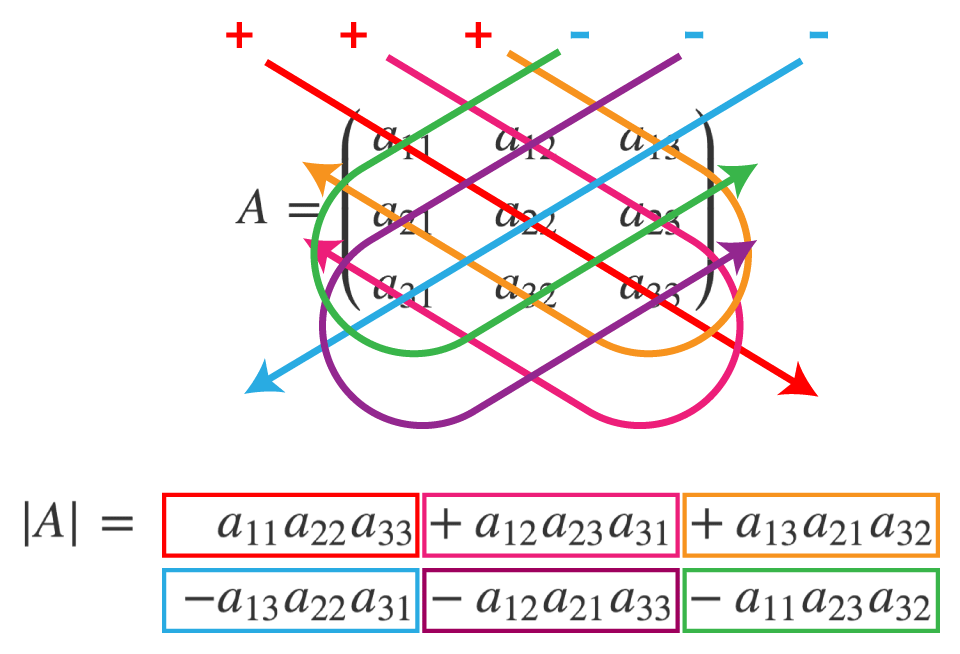
对于矩阵 (通常为方阵) A_{n \times n},我们定义其行列式为:
其中 P_n 表示长度为 n 的所有排列的集合,\operatorname{sgn}(p) 表示 (-1)^{排列 p 中的逆序对的个数}。
这里有一张快速求解行列式的图:
性质
- 对矩阵做行 (列) 交换,行列式反号。
根据排列的奇偶性,我们可以知道交换一个排列中的一对元素,其排列奇偶性也会发生变化,所以 \operatorname{sgn}(p) = -\operatorname{sgn}(p^{\prime}),证毕。 - 对矩阵做行 (列) 数乘,行列式乘上同样的常数
我们知道一个排列包含 [1,n] 之间的所有整数,所以被修改的元素会在每个连乘中出现且每个连乘中仅出现一次,所以可以提到整个式子的前面,证毕。 - 对矩阵做行 (列) 加法,行列式不变。
求解行列式
#include <bits/stdc++.h>

using namespace std;

constexpr int N = 605;
int n;
long long p;

class Matrix {
	long long mat[N][N] = {{}};
	int size = 0;

	public:
	Matrix() = default;

	void get_input(int n) {
		size = n;

		for (int i = 1; i <= size; i++) {
			for (int j = 1; j <= size; j++) {
				cin >mat[i][j];
			}
		}
	}

	long long det(const long long ModValue) {
		long long retval = 1, sgn = 1;

		for (int i = 1; i <= size; i++) {
			for (int j = i + 1; j <= size; j++) {
				while (mat[i][i]) {
					long long divide = mat[j][i] / mat[i][i];

					for (int k = 1; k <= size; k++) {
						mat[j][k] = (mat[j][k] - divide * mat[i][k] % ModValue + ModValue) % ModValue;
					}

					sgn = -sgn;
					swap(mat[i], mat[j]);
				}

				sgn = -sgn;
				swap(mat[i], mat[j]);
			}
		}

		retval = sgn;
		for (int i = 1; i <= size; i ++) {
			retval = retval * mat[i][i] % ModValue;
		}

		return (retval + ModValue) % ModValue;
	}
} matrix;

int main() {
	ios::sync_with_stdio(false);
	cin.tie(nullptr);
	cout.tie(nullptr);

	cin >n >p;

	matrix.get_input(n);

	cout << matrix.det(p) << '\n';

	return 0;
}
矩阵树定理 (根本听不懂啊)
矩阵树定理是把图的生成树个数和矩阵行列式联系起来的一个定理。
矩阵树定理
对于无自环 (允许重边) 的有向图 G = (V, E)。设出度矩阵 D(G),其中 \forall u \in V,D_{u,u}表示点 u 的出度,其余位置全部为 0。而 A(G) 表示图 G 的邻接矩阵,其中 a_{i,j} 表示 i \to j 的边的数量 (i,j \in V)。那么可以得到对应的拉普拉斯矩阵 L(G) = D(G) - A(G)。
L(G) 关于 L(G)_{k,k} 的余子式是以 k 为根节点的内向生成树的个数。
余子式
对于矩阵 A,A_{i,j} 的余子式定义为 A 去掉第 i 行第 j 列的矩阵行列式。
线性基
定义
在 K 维异或空间下,一个向量可以用一个 [0,2^k) 内的整数表示 (即该数在二进制意义下的每一位都表示一个向量)。
对于一组向量 S = \{v_1, v_2, v_3, \dots, v_n\}:
- S 中数字的异或和称为这些向量的线性组合。
- 若不存在非空子集 W \subset S 满足 \bigotimes_{v \in W} v = 0,则称 S 线性无关。
- S 的所有子集的异或和的集合构成 S 的张成,记作 \operatorname{Span}(S)。
- S 的线性基是一个线性无关的向量集合 W,满足 \operatorname{Span}(W) = \operatorname{Span}(S)。
- K 维空间的线性基 W 满足 \left\vert W \right\vert = K。
2025 Summer Day4
本文采用 CC BY-NC-SA 4.0 许可协议,转载请注明出处。
评论交流
欢迎留下你的想法